
AI Thesis #1 (Draft)

What if Martin Luther lived in 2025 and was trying to reform education or edtech?
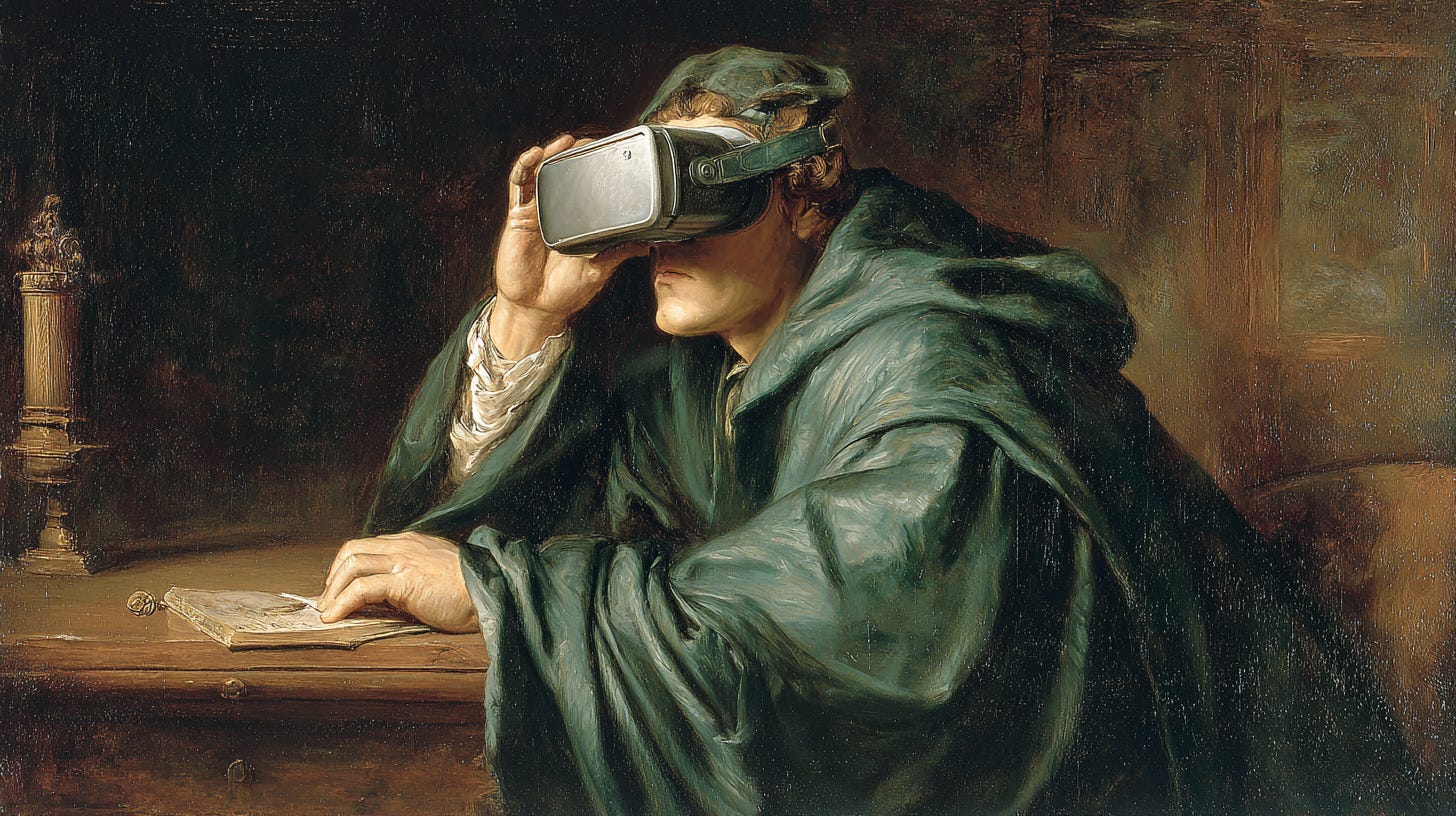
When John Dewey said, “education is not preparation for life; education is life itself,” he willed the entire system to be an active, social process of living—not a rehearsal for it. True education is not a show for a future audience, not a stand-in for genuine problems, not a shadow of the real thing. Education is grappling with the unknown in the here and now, reconstructing our experience so we can participate in and shape a changing world rather than merely cope with it. If education is life, then learning is living: active, vital, bustling, changing, challenging.
I’ve seen this most vividly in speech and debate. Students board a bus on a Saturday morning, clutching scripts and notes, heading into classrooms not their own to perform for strangers who represent an indifferent world. Then comes the bus ride home. Results are posted. The sting lands. A student who poured weeks into a performance sees a low ranking. Outrage arrives first—“I was better than that person. The judge didn’t get it.” But for most, that spark of indignation becomes the fuel for real learning. It’s the first time they confront the gap between intent and impact. Learning ceases to be rehearsal; it becomes a raw, public negotiation with how their words land in the world of strangers.
Thus, using AI in education demands continual reflection because the system magnifies whatever we bring to it. AI is a mirror—our bias, our blind spots, our wisdom feed its output. Ethical use requires daily self-examination as much as technical skill. Without continual reflection, using AI becomes like moving blindfolded across a rippling, rushing river.
Reflection Questions for AI Thesis #1
What’s the “one-time event” mindset in AI adoption?
What do educators treat as a checkbox moment rather than an ongoing practice? (e.g., “I took the AI PD,” “I tried ChatGPT once.”)What does “entire life” look like in AI use?
If repentance is daily/continuous, what’s the AI equivalent? What has to become a consistent practice rather than an occasional experiment?What shift in stance or posture is required?
Luther isn’t just asking for behavior change—he’s asking for a whole orientation of life. What orientation shift does AI demand from educators?
Original Thesis #1 (Luther)
Text:
“When our Lord and Master Jesus Christ said, ‘Repent’ (Mt 4:17), he willed the entire life of believers to be one of repentance.”
Grammar Pattern:
Structure: Declarative reinterpretation — “When Christ said X, he willed Y.”
Function: Establishes a foundational principle.
Movement: Takes a single command → expands it to “entire life.”
Tone: Bold, comprehensive, ongoing.
Context:
This is the foundational thesis. Everything else flows from it. Luther takes Christ’s command to “repent” and reframes it as an ongoing posture—not a one-time event.
Love this sentence - AI is a mirror—our bias, our blind spots, our wisdom feed its output. Ethical use requires daily self-examination as much as technical skill. Without continual reflection, using AI becomes like moving blindfolded across a rippling, rushing river. Let's get that line into the Summit:-)